
Dr Alex Voisey is a Lecturer in Medical Pharmacology at Cardiff University, Chair of the British Pharmacological Society’s Early Career Pharmacologist Advisory Group, and a Fellow of the Society.
His work centres on the integration of digital and emerging technologies into pharmacology education, particularly interactive learning and the role of generative AI in teaching and assessment.
He contributes to shaping institutional approaches to AI-enabled education and staff development, with a focus on building inclusive, future-facing and practice-aligned learning environments.
Pharmacology Education in the AI Epoch: Lessons in effective and ethical use
Generative AI (GenAI) has become an unavoidable reality of higher education. In 2025 the Higher Education Policy Institute reported that 88% of students are using some form of GenAI in their assessments (1). Many institutions have flipped from initial prohibition to adoption of AI, aiming to foster a culture of student transparency. Yet our own findings within the BSc Medical Pharmacology course at Cardiff University reveal a more complex picture. Students often use GenAI superficially, missing the opportunities for deeper learning. Others under-report their use, possibly out of fear of academic repercussions. This signals a mismatch between student behaviour, institutional policy and pedagogical practice.
If we accept that pharmacology students will use GenAI, then the question becomes: how do we ensure students use GenAI effectively, ethically and critically? In short: how do we build AI literacy?
AI advancements are outpacing curriculum design, staff development, and university policy. No educator (including myself) can truly be an “AI expert” in this vast and rapidly evolving landscape. Despite a general acceptance of student AI use, many institutional responses remain stuck in a binary mindset of prohibition and permission. Masquerading risk management as pedagogy is not the way forward. Pharmacology education requires AI literacy, as a taught core competency of the undergraduate pharmacology curriculum.
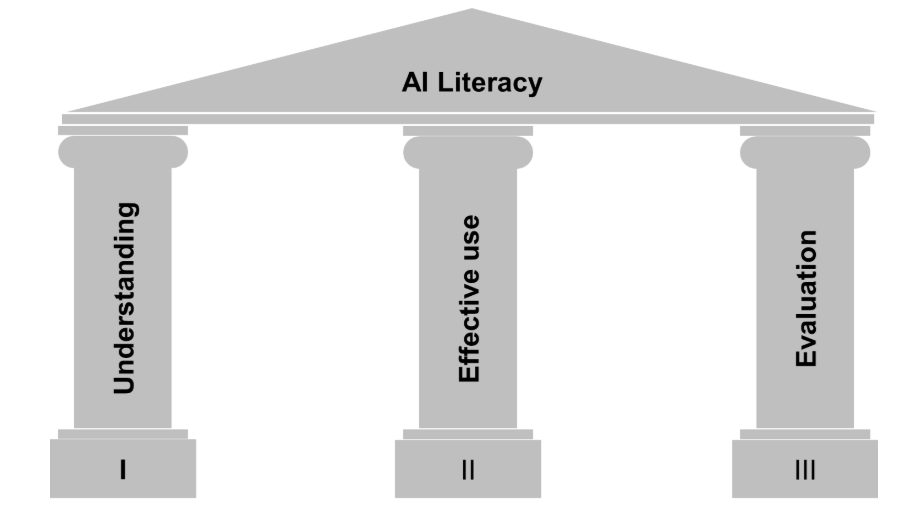
The Three Pillars of AI Literacy
Pillar 1 - Understanding
Students must first understand what AI is and what AI is not. This includes the difference between AI and GenAI. Large language models (LLM), which underpin GenAI, generate outputs based on patterns. They do not verify facts, interpret meaning or recognise flawed science and they are dependent on their training data and user feedback. This explains why they hallucinate, how bias creeps into outputs and importantly why LLMs cannot assess validity of scientific work.
Pharmacology students must understand that AI tools cannot identify poor experimental design and methodology or fabricated literature and may generate convincing but incorrect outputs, known as hallucinations. These are competencies students must develop independently. They must also be aware of data and intellectual property risks, what can be input safely and why research data must not. In pharmacology, failure to correctly interrogate outputs can lead to acceptance of flawed experimental designs and fabricated data. The risks developing graduates that propagate these errors into research and in clinical settings patient care contexts. In this regard AI literacy is no longer just an academic skill but also a safety competency of pharmacologists.
Pillar 2 – Effective Use
Once students understand model limitations they can begin supervised, intentional use. This includes structured prompting techniques for LLMs such as roleplaying,” explain it like I’m five”, and structured formatting to organise complex ideas. Model selection is equally important, LLMs are generalists, but many specialised AI tools exist for specific tasks such as summarising (e.g Googles notebookLM) and literature searching (Elicit or SciteAI).
Crucially students learn to apply their understanding of AI to support conceptual data analysis and experimental design without inputting raw or sensitive data. When used well, AI scaffolds learning, enabling students to expand their understanding without avoiding the underlying cognitive work. Aligning closely with Vygotsky’s Zone of Proximal Development (2) where learners progress through guided support.
Pillar 3 – Evaluation
Evaluation is the most critical pillar. Students must evaluate AI outputs with the same rigour they would apply to scientific literature. This includes identifying fabricated references, logical inconsistencies and inaccurate claims.
My workshops exploits the contrast in evaluation skills between a subject expert and learner using a paired critical analysis activity. Each student selects a topic where they are the expert and their partner is a novice (e.g films, sports or literature). They prompt an AI model to generate a 500-word summary including references. They then critique the output individually before swapping summaries with their partner and repeating.
As subject experts, students immediately detect inaccuracies, missing key facts, fraudulent references or untrustworthy sources. In their novice subject, students were quick to accept errors without critique because the content “sounds plausible”. The activity makes the expert-novice gap visible and instils in students the pedagogical truth that without evaluative skills, AI’s confidence is dangerously persuasive.
Conclusion to the pillars
The foundation of AI literacy depends on all three pillars. Understanding without effective use is passive, effective use without evaluation is dangerous, and evaluation without understanding is superficial. Literacy requires all three working together.
Student Impact
Data from assessments across the Cardiff Pharmacology programme reveal how students are using AI. Many rely on AI to interpret assessment guidelines, format written work, strengthen conceptual understanding, enhance ideas or refine drafts. When used critically, AI acts as a learning enhancer rather than a shortcut. Students using AI responsibility engage strongly with the literature demonstrating co-creation and not reliance. Poor AI use tends to be associated with misinterpretation of the assessment, acceptance of fabricated references and failure to detect inaccuracies reflecting gaps in evaluative skills (pillar 3). The problem is not AI use itself, but the absence of literacy guided use.
Towards a pedagogical future
The future of pharmacology education starts with AI literacy. AI literacy can serve as the scaffold to design and integrate AI into learning and authentic assessment. Beyond academia, AI is shaping research and innovation. AI literacy is now a core competency of future pharmacologists. Pharmacology Educators can lead the way by preparing our students to work critically with tools they are already using.

1. Freeman J. Student generative ai survey 2025. Higher Education Policy Institute: London, UK. 2025.
2. Vygotsky LS, Cole M. Mind in society: Development of higher psychological processes. Harvard university press; 1978.